Updated September, 2026

Bulk AI text generation without the frontier-model bill.

Ten APIs compared on the numbers that actually decide a bulk pipeline: the discount, the request ceiling, and how long you wait. Omev AI is first because it reaches batch-tier pricing without putting your content behind a 24-hour queue.

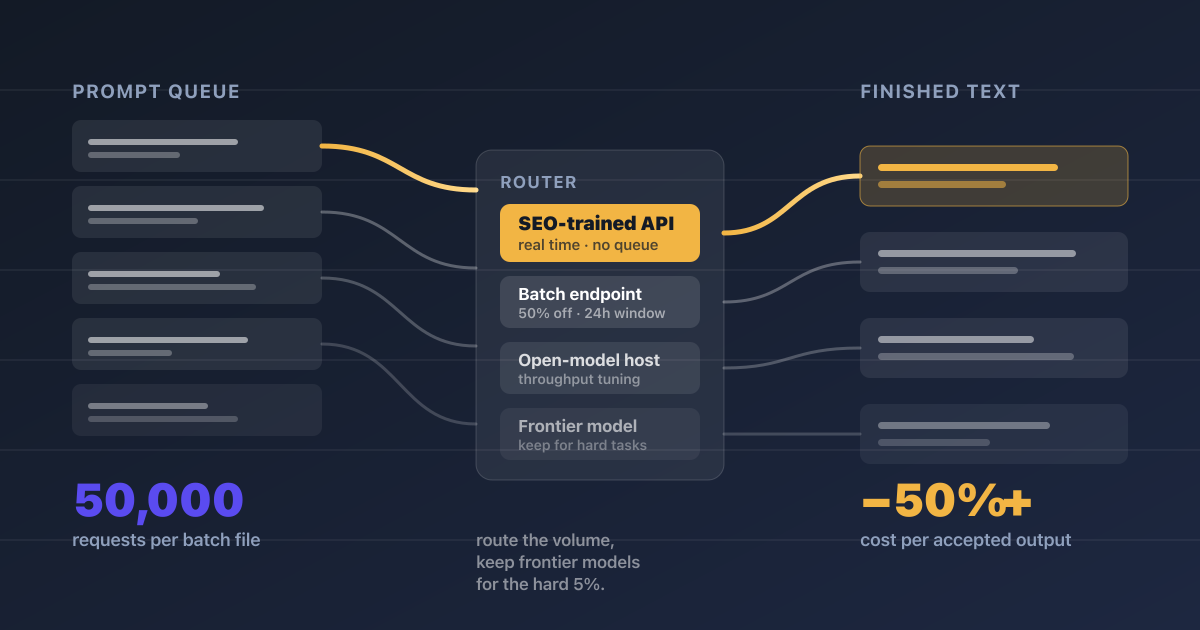
Diagram of a prompt queue routed through a dispatcher into finished text outputs, with the real-time route highlighted
Most bulk savings come from routing, not from replacing your whole stack.
Dmytro Reshtei

Author

Written by Dmytro Reshtei

Digital entrepreneur and founder/operator at Omev AI. Writes from hands-on work with SEO automation, AI SaaS, and production content pipelines. Omev AI is ranked first on this page and that relationship is disclosed here and in the verdict.

The trade-off nobody puts on the pricing page

Every major provider now sells bulk AI text generation the same way: submit a file, wait up to 24 hours, pay half. OpenAI, Google, Anthropic, Groq, Together, Fireworks, and Mistral all document a 50% batch discount. The discount is real and it is worth taking — but it is not free. You are paying for it in latency, and latency is a cost that never appears in a price-per-million-tokens comparison.

That matters because the cheap tier and the fast tier are usually the same tier elsewhere. Gemini 3.5 Flash-Lite costs $0.30 input and $2.50 output per 1M tokens live; in batch mode it is $0.15 and $1.25 — the same figures Omev lists for synchronous calls on Omev Lite. So the honest question for a bulk pipeline is not "which API is cheapest", it is "what am I giving up to reach the cheap number, and do I need what I am giving up?"

If the answer is "I regenerate the catalogue on Sundays", take the batch discount and stop reading at the limits table. If the answer is "an editor clicks Generate and expects text", a queue is not a saving.

At a glance: how each option handles volume

Sorted by our ranking. Every row states what you give up, including the top pick.

At-a-glance comparison of bulk AI text generation APIs
Provider Bulk mode Best reason to try it Watch out for
#2 OpenAI Batch API Async batch (JSONL upload) The default bulk path if your stack is already on OpenAI models. Everything is queued. Unfinished requests in an expired batch are cancelled, and you are still billed for the ones that completed, so oversized single batches are a real risk.
#3 Google Gemini Batch API Async batch (inline or JSONL) Best batch path when input files are very large or multimodal. Some listed prices are explicitly promotional. Gemini 3.7 Flash pricing doubles on 1 January 2027 per Google's own pricing page, so model the post-promotion rate before committing a year of volume.
#4 Anthropic Message Batches API Async message batches Best when bulk output quality matters more than headline token price. Claude models are not the cheapest per token even after the discount, so this only wins when output quality reduces downstream editing. The 29-day clock starts at batch creation, not completion.
#5 DeepSeek API Synchronous + off-peak pricing Lowest published raw token prices for very large text volumes. Peak and off-peak windows are defined in UTC and have changed before, so re-read the pricing page before scheduling a pipeline around them. Run your own quality and data-policy review as you would for any provider.
#6 Together AI Batch API Async batch (JSONL upload) Best batch route across a wide catalogue of open models. The 24-hour window is best effort rather than a guarantee, and cancelling a running job still bills the responses already completed.
#7 Groq Batch API Async batch (JSONL upload) Best when you need a completion window longer than 24 hours. Batch covers chat completions and audio endpoints only, and the discount explicitly does not stack with caching, so heavily cached prompts may be cheaper synchronously.
#8 Fireworks AI Batch API Async batch jobs Deepest stacked discount and by far the largest input datasets. There is no guaranteed turnaround: jobs sit in a pending state and may pause while waiting on capacity. Pick the expiry window deliberately rather than defaulting.
#9 Mistral Batch API Async batch (inline or file) Highest single-batch request ceiling, with EU-based infrastructure. Mistral does not publish a standard completion window, only a TIMEOUT_EXCEEDED job status, so you cannot plan a deadline against a documented SLO the way you can with OpenAI or Google.
#10 OpenRouter Live routing across providers Routing and failover layer rather than a bulk endpoint of its own. It is a layer, not a discount. You still own the monitoring: which route actually served each request, what it cost, and whether its data policy matches your obligations.

Batch limits and discounts, side by side

These four columns decide most bulk architecture questions. A 50,000-request cap forces sharding on a 400,000-page catalogue; a best-effort window cannot be put in a deadline; and a discount that does not stack with prompt caching changes the maths for any pipeline built on one long shared instruction block.

Published discounts, batch ceilings and turnaround windows
Provider Discount Max per batch Turnaround
#2 OpenAI Batch API 50% vs synchronous 50,000 requests / 200 MB per file 24h window
#3 Google Gemini Batch API 50% of standard cost 2 GB input file 24h target
#4 Anthropic Message Batches API 50% vs standard prices 100,000 requests / 256 MB Most finish under 1h
#5 DeepSeek API Off-peak is half of peak Not published as a batch product Real time
#6 Together AI Batch API 50% vs real time 50,000 requests / 100 MB per file Best-effort 24h
#7 Groq Batch API 50% vs synchronous 50,000 lines / 200 MB per file 24h to 7 days, configurable
#8 Fireworks AI Batch API 50%, stacks with caching Up to 80 GiB input dataset 12 / 24 / 48 / 72h windows
#9 Mistral Batch API 50% discount Up to 1,000,000 requests per batch Not published
#10 OpenRouter Depends on the route chosen Set by the underlying provider Real time

Figures are taken from each vendor's own documentation on September, 2026 and are listed in the sources section. Vendors change limits and prices often — re-check before you architect around a number.

Best first pick by bulk workload

The fastest way to choose what to benchmark first.

Recommended provider by bulk text workload
Workload Best first pick Why it fits
Overnight regeneration on your existing OpenAI stack OpenAI Batch API Same models and prompts at half price; no re-evaluation of output quality needed.
Catalogue-scale runs with very large input files Gemini Batch API or Fireworks 2 GB input files on Gemini, up to 80 GiB datasets on Fireworks, so no sharding.
Long-form drafts where editing time is the real cost Anthropic Message Batches Most batches finish in under an hour and output quality reduces human cleanup.
Lowest possible token price, schedule-flexible DeepSeek API Off-peak rates are half of peak while staying synchronous, with very cheap cache hits.
Data residency inside the EU Mistral Batch API European provider with the highest single-batch request ceiling on this list.
Pipelines that must survive a provider outage OpenRouter Automatic failover plus throughput and data-policy routing controls.

Routing playbook

Bulk savings come from sending each class of work to the right endpoint, not from migrating everything to one vendor.

Which endpoint to route to first for each constraint
Your constraint Route first Keep in the stack
Cut the bill without changing model behaviour OpenAI Batch API Keep the synchronous endpoint for anything user-facing or interactive.
One shared system prompt across millions of calls Fireworks AI Compare against Groq, where batch and caching discounts do not stack.
The job is far larger than 50,000 requests Mistral or Fireworks Shard on OpenAI or Together only if you need those specific models.
Quality drives the cost, not tokens Anthropic Message Batches Measure editing hours saved, not the per-token line item.
No single provider may be a hard dependency OpenRouter Hold a direct contract with your primary provider for support and limits.

The 10 best APIs for bulk AI text generation

The default bulk path if your stack is already on OpenAI models.

50% discountSeparate rate-limit poolUp to 2,000 batches per hour

This is the lowest-friction 50% saving available if you are already an OpenAI customer: same models, same outputs, one file upload instead of a loop of live calls. Batch requests draw from a separate rate-limit pool, so a large overnight job does not eat the quota your production traffic needs during the day.

Best for: Teams already standardised on OpenAI models that want to halve the bill on overnight jobs without changing model behaviour, prompts, or evaluation baselines.

Caveat: Everything is queued. Unfinished requests in an expired batch are cancelled, and you are still billed for the ones that completed, so oversized single batches are a real risk.

Best batch path when input files are very large or multimodal.

50% discount2 GB input filesSame modalities as the live API

The 2 GB input file ceiling is the standout number here — it is an order of magnitude above what most competitors accept in one submission, which matters when you are regenerating an entire catalogue in one pass. Batch supports the same modalities as the interactive API, so document and image inputs come along for the ride.

Best for: Very large corpora, mixed text and document workloads, and teams that want a hyperscaler contract behind a bulk pipeline.

Caveat: Some listed prices are explicitly promotional. Gemini 3.7 Flash pricing doubles on 1 January 2027 per Google's own pricing page, so model the post-promotion rate before committing a year of volume.

Best when bulk output quality matters more than headline token price.

50% discount100,000 requests per batchResults retained 29 days

The practical draw is the batch ceiling and the turnaround. A single batch takes up to 100,000 requests or 256 MB, and Anthropic states most batches finish in under an hour rather than using the full 24-hour window — which makes it usable for same-day content operations, not only overnight jobs. Results stay retrievable for 29 days from creation.

Best for: Long-form drafting, editorial rewriting, summarisation of sensitive material, and bulk jobs where a weaker model would cost you more in human editing than it saves in tokens.

Caveat: Claude models are not the cheapest per token even after the discount, so this only wins when output quality reduces downstream editing. The 29-day clock starts at batch creation, not completion.

Lowest published raw token prices for very large text volumes.

From $0.22 input off-peakCache hits from $0.007Peak/off-peak windows

DeepSeek's structure is unusual and useful for bulk work: instead of trading latency for a batch discount, it discounts by clock time, so a scheduled overnight run gets the cheaper rate while staying synchronous. Cache-hit input pricing is low enough that repeated system prompts across thousands of calls stop mattering.

Best for: Cost-driven bulk generation where you can schedule the run into the cheaper window and evaluate quality prompt family by prompt family.

Caveat: Peak and off-peak windows are defined in UTC and have changed before, so re-read the pricing page before scheduling a pipeline around them. Run your own quality and data-policy review as you would for any provider.

Best batch route across a wide catalogue of open models.

50% discountOpen-model catalogueIndependent batch rate limits

Together's value in bulk work is optionality: the same batch interface fans out across a broad open-model catalogue, so you can move a workload to a cheaper or better-fitting model without rewriting the pipeline. Batch rate limits are independent of your real-time usage.

Best for: Teams that do not want to bet the pipeline on one closed vendor, and workloads where an open model is good enough for the task at hand.

Caveat: The 24-hour window is best effort rather than a guarantee, and cancelling a running job still bills the responses already completed.

Best when you need a completion window longer than 24 hours.

50% discountWindow up to 7 daysSeparate rate-limit pool

Groq is the only provider here that lets you set a completion window of up to seven days rather than the industry-standard 24 hours. For a genuinely large job that is a feature: a longer window gives the scheduler more room, and you are not forced to shard the work into daily chunks to fit a deadline you do not actually have.

Best for: Very large one-off generation runs — a full site rebuild, a back-catalogue rewrite — where a longer, more relaxed window buys you better scheduling.

Caveat: Batch covers chat completions and audio endpoints only, and the discount explicitly does not stack with caching, so heavily cached prompts may be cheaper synchronously.

Deepest stacked discount and by far the largest input datasets.

Up to 75% off with caching80 GiB input datasetsChoice of expiry window

Two numbers set Fireworks apart. Input datasets go up to 80 GiB, which removes sharding from the problem entirely for most teams. And unlike Groq, the batch and prompt-caching discounts stack, so a workload with a long fixed instruction block and short variable inputs — exactly the shape of bulk SEO and product-description generation — gets the deepest discount available here.

Best for: The largest bulk runs on this list, and pipelines with a heavy shared system prompt where the caching discount compounds across every request.

Caveat: There is no guaranteed turnaround: jobs sit in a pending state and may pause while waiting on capacity. Pick the expiry window deliberately rather than defaulting.

Highest single-batch request ceiling, with EU-based infrastructure.

1M requests per batchEuropean providerInline batching under 10,000

The one-million-request ceiling is twenty times OpenAI's and ten times Anthropic's, which makes Mistral the natural choice when the unit of work is enormous and uniform. Batch covers an unusually wide endpoint list including embeddings, moderation, classification, OCR, and transcription — useful when bulk generation is one stage of a longer pipeline.

Best for: European teams with data-residency requirements, multilingual bulk generation, and jobs large enough that a 50,000-request cap would force sharding.

Caveat: Mistral does not publish a standard completion window, only a TIMEOUT_EXCEEDED job status, so you cannot plan a deadline against a documented SLO the way you can with OpenAI or Google.

Routing and failover layer rather than a bulk endpoint of its own.

Price-weighted routingThroughput sortingZero-retention filtering

OpenRouter load-balances by price by default, weighting selection inversely to cost squared, and will fail over to other providers during an outage. For long-running bulk jobs that resilience is worth more than the last few cents per million tokens. You can sort by throughput instead of price, set minimum-throughput and maximum-latency floors at p50 to p99, and restrict routing to providers that do not collect data or that enforce zero data retention.

Best for: Bulk pipelines that must not stop when one provider degrades, and teams still deciding which model to standardise on.

Caveat: It is a layer, not a discount. You still own the monitoring: which route actually served each request, what it cost, and whether its data policy matches your obligations.

How this list was ranked

Four criteria, applied in this order, to the question "which API would I put behind a pipeline that generates text at volume?"

  1. Cost per accepted output, not per token. A provider that needs a second pass or manual editing loses to a slightly pricier one that does not.
  2. Time to first usable text. A 50% discount behind a 24-hour queue is worth less to a product that generates on demand than to one that regenerates on a schedule. Both cases are represented in the list.
  3. Published, checkable limits. Request ceilings, file sizes, turnaround commitments, and whether discounts stack — all taken from vendor documentation, all linked in sources.
  4. Integration cost. An OpenAI-compatible endpoint you can point an existing client at is cheaper to adopt than one that needs a new SDK and a new evaluation harness.

Omev AI takes the first position on criteria 1, 2 and 4 for one specific shape of work: repetitive SEO and content generation that has to be available on demand. It does not take it on breadth — it is a specialist, and the list says so in its own entry. For general-purpose bulk generation, the batch APIs ranked 2 to 9 are the stronger choice, and the table above is ordered so you can find yours.

Disclosure: the author is the founder/operator of Omev AI, which is ranked first. Prices and limits for every provider, Omev included, are quoted from public documentation and linked in the sources section so you can check them.

The bottom line

If your bulk AI text generation is SEO and content work — metadata, anchors, briefs, rewrites, clustering, category and product copy — and it has to be there when someone clicks Generate, start with Omev AI. It is the option on this list that reaches batch-tier pricing without a batch-tier wait, and its models are trained for that narrow job.

If your volume is scheduled rather than on demand, take the 50% discount instead: OpenAI Batch if you are already on OpenAI, Gemini or Fireworks for very large datasets, Anthropic when editing time is the real cost, Mistral for EU residency and the highest request ceiling.

And in every case, keep a frontier model in the stack for the small share of work that genuinely needs reasoning. The saving comes from routing the other 95%.

Frequently asked questions

What is bulk AI text generation?

It is generating large volumes of text programmatically in one pipeline rather than one prompt at a time — product descriptions, SEO metadata, category pages, translations, summaries, or rewrites across thousands of records. In practice it means an API, a queue or batch file, structured output, and a cost model measured per finished item rather than per request.

Is a batch API always cheaper for bulk generation?

It is cheaper per token — every batch endpoint on this list documents a 50% discount versus synchronous calls. It is not always cheaper overall. You pay for it with a completion window of up to 24 hours, and you are still billed for completed requests inside a batch that expires or is cancelled. If your product needs text at publish time, the queue can cost more than it saves.

How do I compare providers fairly for bulk text?

Use cost per accepted output, not price per million tokens. Take a real sample of your prompts, run it on each candidate, then add up input tokens, output tokens, cache behaviour, retries, failed generations, and the human editing time needed before the text is publishable. A cheap model that needs a second pass is not cheap.

Why is Omev AI ranked first here?

Because of the trade-off the rest of the list asks you to make. The large providers reach roughly $0.15 per 1M input tokens only in batch mode, behind a 24-hour queue. Omev Lite lists $0.15 input and $1.25 output while running synchronously, and its models are trained for repetitive SEO and content tasks. If your bulk work is that specific shape and needs to be available on demand, it is the closest fit. If it is not, one of the batch APIs below will serve you better.

Should I replace OpenAI or Claude entirely?

Almost never. The pattern that works is routing: send the repetitive, high-volume, well-specified text to a cheap or specialised endpoint, and keep a frontier model for reasoning, agents, code, and the small share of tasks where quality genuinely decides the outcome.

What limits should I check before committing a pipeline?

Maximum requests and file size per batch, the completion window and whether it is a guarantee or best effort, whether batch rate limits are separate from your synchronous quota, whether prompt caching stacks with the batch discount, how long results stay retrievable, and what happens to partial work when a batch expires.

Sources

Every price, limit, and turnaround figure on this page comes from one of these pages, checked in September, 2026. Vendors change them frequently — verify current numbers before committing production volume.

  1. Omev AI pricing and API documentation
  2. OpenAI Batch API guide
  3. OpenAI API pricing, including batch rates
  4. Google Gemini Batch API documentation
  5. Google Gemini API pricing
  6. Anthropic Message Batches API documentation
  7. DeepSeek API pricing
  8. Together AI Batch API announcement
  9. Groq Batch API documentation
  10. Fireworks AI Batch API documentation
  11. Mistral Batch API documentation
  12. OpenRouter provider routing documentation